
Engineering the Ultralight Tee
When we set out to build the Ultralight Tee, the brief was intentionally extreme: create a performance running shirt that disappears on the body.
Not light. Not lightweight. Invisible.
Starting with Weight
60 grams. That's the target we set for a men's medium. It's roughly the weight of a standard envelope. For context, most technical running tees land between 120–180g. We were aiming for half of that.
The first question was whether it was even possible without compromising the properties that make a running shirt functional — moisture transport, durability, shape retention after hundreds of washes, and the structural integrity to survive repeated friction across long distances.
The answer, after 14 months of development, was yes. But it required rethinking almost every assumption about how technical fabric is constructed.
The Fabric Architecture
Standard technical fabrics work by blending fibers of different diameters. The result is a textile with decent performance characteristics but a density that reflects a compromise: good enough at moisture management, good enough at weight, good enough at durability.
We rejected the compromise.
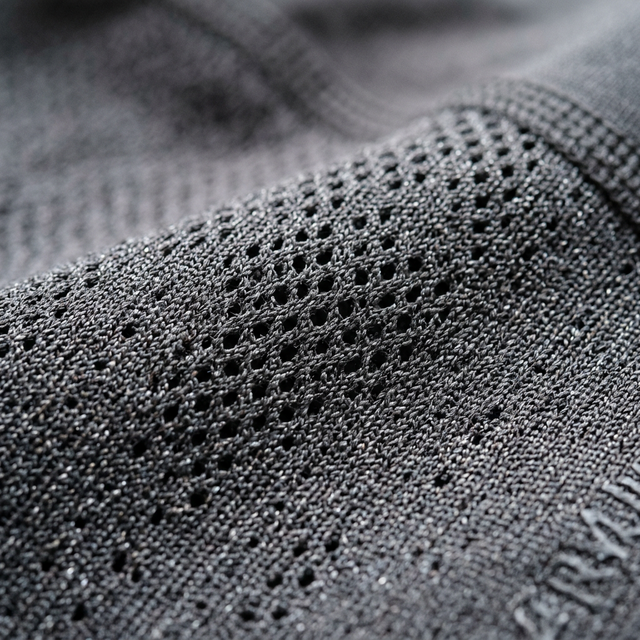
The Ultralight Tee uses a mono-filament weave structure — a single continuous thread of 20-micron polyester, engineered with a hexagonal cross-section rather than a round one. The flat faces of the hexagonal fiber increase surface area without increasing mass, which dramatically improves wicking velocity. Moisture doesn't just absorb — it actively moves.
The weave itself is an open-mesh construction, which sounds counterintuitive for a garment meant to last. But the geometry of the mesh — each junction point heat-bonded rather than interlocked — distributes tension across the entire surface rather than concentrating it at stress points. A shirt that absorbs force rather than resisting it is a shirt that doesn't tear.
The Seaming Problem
Traditional seaming adds weight and creates friction points. A 3mm flat-lock seam along a shoulder runs for 40–50cm. Over the course of a marathon, that seam contacts skin approximately 48,000 times. For most runners, that's a tolerable irritation. For long-distance athletes, it's a real injury vector.
We moved to a bonded seam construction — a 0.8mm adhesive weld that joins panels without any overlapping material. The weld is stronger than the fabric itself under tensile load, adds under 1 gram to the total weight, and presents a perfectly smooth surface to the skin.
60g in Practice
The first time most people hold the Ultralight Tee, they check the tag. They're expecting a catch — mesh panels, ultra-thin sections that won't hold up, something that explains why it weighs almost nothing.
There's no catch. It's just the result of not accepting the first answer.
We ran it through 300 wash cycles in accelerated testing. We had athletes complete back-to-back training weeks in Bangkok heat — 34 degrees, 85% humidity — to stress-test the wicking system. We put it through tensile testing equivalent to 5 years of regular use.
It held. The 60g held.
If you've been running in the same category of shirt for years, put this one on for a 10km and you'll understand what we mean when we say it disappears.